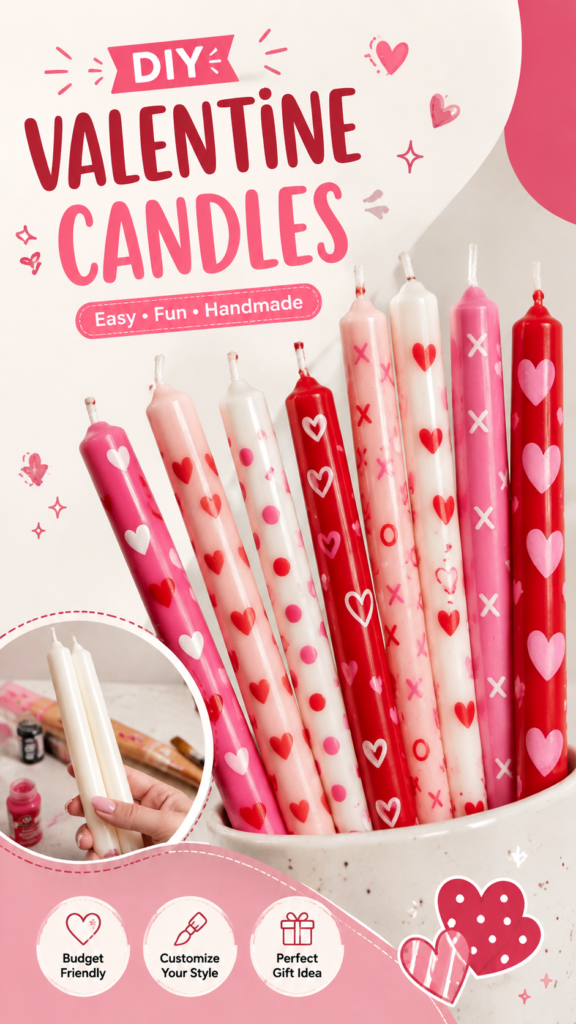
Valentine’s Day is the perfect excuse to turn a simple everyday item into something colorful, personal, and full of charm. These decorated tapered candles show just how much personality can be added with a few creative patterns, playful colors, and handmade details. Hearts, dots, Xs, tiny marks, and romantic motifs transform ordinary candles into eye-catching pieces that work beautifully as seasonal decor or thoughtful handmade gifts.
If you love Valentine’s DIY crafts, this project is especially appealing because it combines creativity with simple decorative techniques. You can experiment with red, pink, white, and soft pastel shades, create matching sets, or give every candle its own unique design. The result is a collection that feels festive without requiring complicated decorations.
Key Takeaways
- Decorated taper candles can become simple and charming Valentine’s Day decor.
- Heart patterns, dots, Xs, and small decorative marks create an easy handmade look.
- A limited palette of red, pink, and white keeps a candle collection visually cohesive.
- Different patterns allow you to personalize each candle for your own style or recipient.
- Handmade candles can work as seasonal centerpieces, shelf accents, or thoughtful gift additions.
- Always choose candle-safe decorative materials and follow the candle manufacturer’s safety guidance.
Why Valentine’s DIY Candles Are So Charming
There is something naturally appealing about handmade Valentine’s decorations. Instead of relying on mass-produced pieces that look identical, a DIY project gives you the opportunity to create something that reflects your personality. Taper candles are particularly useful for this because their tall, narrow shape provides plenty of visual space for patterns.
The candles shown in this style feature a playful mixture of romantic colors and graphic motifs. Some designs are covered with hearts, while others use dots, crosses, rings, or small abstract marks. Combining several patterns makes the finished arrangement feel collected and creative rather than overly coordinated.
That flexibility is one of the biggest advantages of a Valentine’s candle project. You do not have to make every candle identical. In fact, a coordinated assortment often looks more interesting. Choose a few repeating colors, then let the patterns change from candle to candle.
Important: The most attractive handmade candle collections usually have one visual element that ties everything together. For Valentine’s candles, repeating colors such as pink, red, and white can provide that connection even when every pattern is different.
Choosing a Valentine’s Day Color Palette
Color is one of the easiest ways to make a DIY candle collection feel unmistakably Valentine-inspired. The classic combination of red, pink, and white works especially well because the colors contrast clearly while still feeling soft and romantic.
Classic Red, Pink, and White
Red creates a bold focal point, pink adds softness, and white provides visual breathing room. You can use one shade as the main candle color and another as the decorative accent. Alternatively, alternate the colors across an entire set.
- Red: Great for statement candles and strong heart patterns.
- Pink: Ideal for playful, soft, and cheerful designs.
- White: Creates a clean base that makes colorful details stand out.
- Blush tones: Add a softer, more contemporary Valentine’s aesthetic.
Keeping the Palette Consistent
You do not need dozens of colors to make the candles interesting. A small palette is often easier to work with and creates a more polished finished display. If your base candles include several colors, repeat at least one accent shade throughout the collection.
For example, a red candle decorated with pink hearts can visually connect with a pink candle decorated with red hearts. A white candle covered with tiny red dots can complete the group. This approach creates variety while maintaining a cohesive Valentine’s Day theme.
Creative Patterns for DIY Valentine Candles
The visual appeal of these candles comes largely from their patterns. You can use simple shapes rather than attempting complicated illustrations. Small repeated elements are surprisingly effective when they are arranged thoughtfully along the length of a taper candle.
Heart Patterns
Hearts are the obvious starting point for Valentine’s crafts. Try large hearts spaced evenly along the candle, tiny hearts scattered randomly, or a combination of different heart sizes. You can also create alternating heart colors for a more playful appearance.
For a subtle look, use small hearts in a single accent color. For a bold design, cover the candle with larger hearts in contrasting shades. Mixing filled and outlined hearts can add another layer of visual interest.
Dots and Circles
Dots are one of the easiest motifs to incorporate into a DIY candle design. They can be arranged in rows, scattered randomly, or grouped into playful clusters. Red dots on a white candle create a clean graphic effect, while pink dots on a red base feel more vibrant.
X and O Motifs
Simple X and O shapes offer a fun alternative to traditional hearts. They can create a casual, youthful pattern and pair naturally with small hearts or dots. Use them sparingly if you want the design to remain elegant, or repeat them across the entire candle for a bold handmade effect.
Mixed Mini Motifs
For a more artistic collection, combine several tiny motifs. A candle might feature hearts, dots, Xs, circles, and small abstract marks. The key is to repeat the same colors so the assortment still feels intentional.
Expert Insight
When creating a patterned candle, think about the entire surface rather than focusing on one small section. Varying the size and spacing of motifs can make a simple design feel much more dynamic. If one candle has a busy pattern, balance it with another candle that uses fewer, larger shapes.
How to Plan Your Valentine Candle Designs
Before decorating, it helps to decide how you want the finished collection to look. Planning does not need to be complicated. A quick sketch or a few notes can help you avoid creating patterns that feel too repetitive.
- Choose two to four main colors.
- Decide whether your candles will share one pattern or use several different designs.
- Select a few simple motifs such as hearts, dots, or Xs.
- Decide whether each candle should be heavily decorated or have plenty of blank space.
- Arrange the finished candles together to check whether the colors and patterns balance visually.
One useful approach is to create a small collection with different levels of decoration. For instance, one candle can be covered with hearts, another can have evenly spaced dots, and a third can feature a more minimal pattern. When grouped together, these differences create depth.
Creating a Handmade Look Without Making It Feel Messy
DIY projects are supposed to show personality, so small variations can actually make the result more charming. At the same time, there is a difference between intentional irregularity and a pattern that feels accidental.
To maintain a polished appearance, repeat a few design rules. Keep your decorative shapes within a similar size range, repeat your main colors, and leave enough breathing room between motifs. If you are using several shapes, distribute them throughout the candle instead of concentrating everything in one area.
Another effective technique is to use one dominant motif and one or two secondary motifs. Hearts can be the main feature, while dots and tiny Xs act as supporting details. This gives the eye something to focus on without making the candle look overly busy.
Pro Tip: Photograph or arrange your finished candles as a group before deciding whether they are complete. A pattern that looks simple on its own can become much more impactful when several coordinating candles are displayed together.
Ways to Style Valentine’s DIY Candles
Once your candles are decorated, the next step is deciding how to display them. Their tall silhouette makes tapered candles particularly useful for adding height to a seasonal arrangement.
Create a Valentine’s Centerpiece
Group several decorated taper candles together as part of a dining table or coffee table display. Mixing heights, colors, and patterns can create an attractive focal point. Keep the surrounding decor simple so the candles remain the stars of the arrangement.
Add Them to a Gift
Handmade candles can also become part of a thoughtful Valentine’s gift. A small coordinated set can be paired with other nonflammable decorative items or packaged as a seasonal craft project. Even a single personalized candle can feel more meaningful than a generic decorative item.
Use Them as Seasonal Decor
You can display decorated candles on a shelf, console, side table, or other suitable decorative surface. Because the colors and motifs are strongly associated with Valentine’s Day, they can instantly add a festive touch without requiring a large collection of decorations.
Making the Project Your Own
The best part of Valentine’s DIY is personalization. There is no single correct pattern for a handmade candle. You can make the design delicate and minimal, colorful and playful, or bold and graphic.
Consider creating candles inspired by the personality of the person receiving them. Someone who prefers simple decor might appreciate a white candle with a few tiny red hearts. Someone who enjoys bright colors could prefer a vibrant mixture of pink and red patterns.
You can also create themed sets. A “heart collection” could use different sizes of hearts across several candles. A playful collection could mix Xs, Os, dots, and hearts. A softer design could rely on pale pink and white with only a few small decorative details.
Candle Safety to Keep in Mind
Because these are decorative candles, safety should always come before appearance. Decorative treatments should be appropriate for the intended candle use, and you should follow the manufacturer’s instructions for burning, placement, and handling.
- Keep burning candles away from curtains, paper, fabric, and other flammable materials.
- Never leave a lit candle unattended.
- Keep candles away from children and pets.
- Use suitable candle holders on a stable, heat-resistant surface.
- Only use decorative materials that are specifically appropriate for candle applications if the candle will be burned.
- If a candle is intended only for decoration, clearly treat it as a decorative object rather than assuming it is safe to burn.
The beautiful patterns are meant to make the candles visually special, but safe use is always the most important part of enjoying any candle project.
Why Handmade Valentine’s Decor Makes a Great Project
DIY Valentine’s candles combine several qualities that make seasonal crafting enjoyable. They are visually expressive, easy to customize, and suitable for many decorating styles. The project also encourages experimentation because even basic shapes can create an attractive result when repeated across a simple form.
More importantly, handmade decor carries a sense of intention. A decorated candle is not just an object in a room. It represents the time spent choosing colors, planning patterns, and creating something with a particular person or occasion in mind.
That personal element is what makes Valentine’s DIY projects so appealing. You can create a collection that looks polished while still retaining the character of something made by hand.
At a Glance
- Best colors: Red, pink, white, and soft blush tones
- Easy motifs: Hearts, dots, Xs, Os, and simple abstract marks
- Best style: Mix coordinated patterns for a collected handmade look
- Great for: Seasonal decor, centerpieces, and thoughtful handmade gifts
- Remember: Follow candle safety guidance whenever candles are used
Conclusion: Make Valentine’s Day More Personal With DIY Candles
Valentine’s DIY candles are a simple way to bring color, creativity, and personality into seasonal decorating. A few carefully chosen colors and uncomplicated motifs can completely change the look of an ordinary taper candle. Hearts, dots, Xs, and playful patterns create a cheerful handmade aesthetic that feels perfect for February celebrations.
Whether you make a coordinated set for your home, create a centerpiece for a special occasion, or prepare a handmade gift, the project gives you plenty of room to experiment. Keep the color palette consistent, vary the patterns, and let your own style guide the details.
The most memorable DIY projects do not have to be complicated. Sometimes, a simple candle decorated with a few thoughtful shapes is enough to make a seasonal display feel personal and special. Choose your favorite Valentine’s colors, gather your creative ideas, and turn a basic candle collection into something uniquely yours.