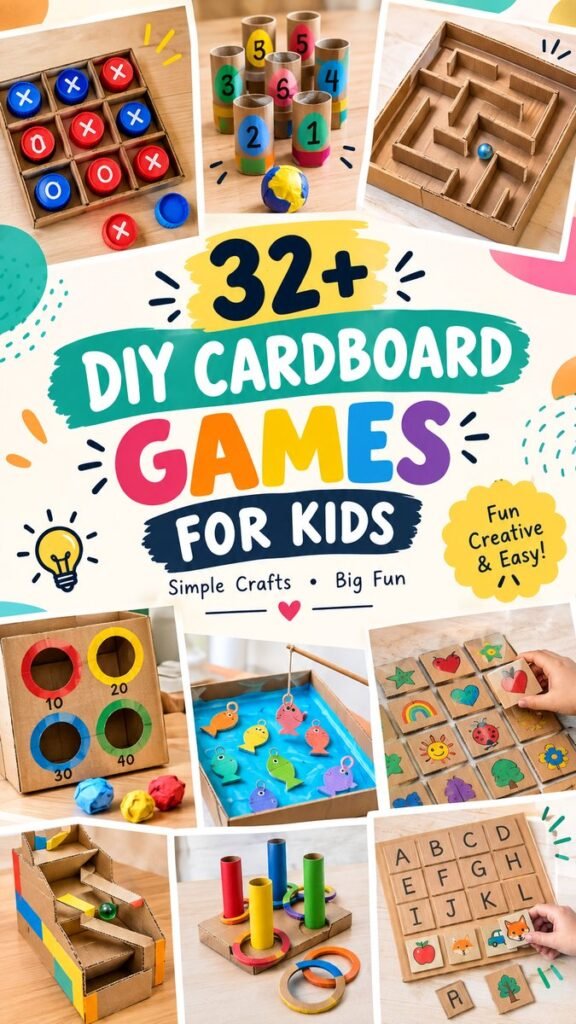
DIY board games are a fantastic way to turn simple cardboard and everyday craft supplies into hours of creative, screen-free fun. With a few basic materials, kids can make games that involve matching, counting, tossing, racing, problem-solving, alphabet practice, and imaginative play. The colorful examples shown here demonstrate just how many possibilities can come from an ordinary cardboard box or a few recycled tubes.
Whether you are planning a rainy-day activity, looking for a classroom project, or simply want a fun weekend craft, homemade board games give children something exciting to create and play. They can also be adapted for different ages and skill levels, making them useful for families with children at different stages of development.
Key Takeaways
- Cardboard can become a wide variety of fun homemade games.
- DIY games encourage creativity, problem-solving, and hands-on play.
- Simple materials such as tubes, bottle caps, paper, and cardboard are often enough.
- Many games can combine learning with playful challenges.
- Children can help design, decorate, and customize their own games.
- Save favorite ideas for future craft sessions, classroom activities, and family game time.
Why DIY Board Games Are So Much Fun
There is something special about playing a game that you made yourself. Instead of simply opening a box and following a set of instructions, children can become part of the creative process from the beginning. They can choose colors, decide how pieces move, invent challenges, and even change the rules once they have tested the game.
That flexibility is one of the biggest advantages of DIY board games. A homemade game does not need to be perfect. A cardboard maze can have a simple layout, a tube bowling game can use decorated paper rolls, and a matching game can be created from small cardboard squares. The goal is to create something that invites children to interact, experiment, and have fun.
Important: The best homemade games are often the simplest ones. Focus on an easy-to-understand objective, colorful pieces, and opportunities for children to make decisions rather than trying to build an overly complicated game.
Creative Cardboard Game Ideas for Kids
The collection of ideas can inspire several different types of DIY board games. Some focus on physical movement, while others encourage matching, counting, recognition, or strategic thinking. You can recreate the basic concept and then change the colors, shapes, rules, and difficulty level to suit the children who will be playing.
1. Cardboard Tic-Tac-Toe
A cardboard tic-tac-toe board is a great beginner project. Create a simple grid and use bottle caps, cardboard circles, or other small objects as the playing pieces. Mark one set with X and another with O, then challenge two players to get three matching pieces in a row.
The board can be decorated with bright colors or personalized with different shapes. For younger children, replace letters with animals, stars, hearts, or other easy-to-recognize symbols.
2. Cardboard Tube Bowling
Save a few empty paper tubes and turn them into a miniature bowling set. Decorate the tubes with numbers, patterns, or different colors. Arrange them in rows and use a lightweight ball to knock them down.
Numbered tubes make the activity even more versatile. Children can count how many pins they knock over, add their scores, or try to beat their previous result. This turns a simple physical game into an easy counting activity.
3. DIY Cardboard Maze
A cardboard maze is another creative project that can be customized in countless ways. Use strips of cardboard to create walls on a flat base, then guide a small ball through the pathways.
Start with a simple route for younger children. Older kids can help design more complicated paths with dead ends and multiple turns. They can also experiment with different maze layouts and challenge friends or family members to complete them.
4. Target Toss Game
A target toss board can be made from a sturdy piece of cardboard with several openings. Give each opening a different number and let players toss soft balls or lightweight objects toward the targets.
This idea is especially easy to adapt. Larger openings can have lower values, while smaller openings can offer more points. The scoring system can be as simple or challenging as the players need.
5. Homemade Fishing Game
A cardboard fishing game adds a playful pretend-play element to craft time. Cut out colorful fish from cardboard and add simple loops or attachment points. A decorated stick can become a pretend fishing rod for collecting the pieces.
To introduce learning, place letters, numbers, colors, or simple pictures on the fish. Children can then be asked to catch a specific letter, number, or color, turning the activity into an interactive learning game.
6. Cardboard Memory Matching Game
Matching tiles are another easy DIY board game idea. Cut cardboard into equal-sized squares and decorate pairs with the same pictures, colors, letters, or shapes. Place the tiles face down and let players take turns finding matching pairs.
The beauty of a homemade memory game is that you can change the theme whenever you like. Use animals for one version, simple shapes for another, or alphabet letters for a learning-focused activity.
7. Alphabet Matching Board
A cardboard alphabet board can combine crafting with early literacy practice. Create a grid with letters and make separate cardboard pieces that children can place into the correct spaces.
You can make the activity easier by using uppercase letters on the board and matching lowercase pieces. Another option is to add simple pictures so children can connect letters with familiar objects.
8. Ring Toss with Cardboard Tubes
Turn cardboard tubes into colorful targets for a homemade ring toss. Secure several tubes to a flat cardboard base and decorate them with different colors or point values. Players then toss lightweight rings toward the targets.
This game can be played indoors with soft materials or taken outside when more space is available. Changing the distance from the targets is an easy way to adjust the challenge.
Materials for Homemade Cardboard Games
You do not need an extensive craft collection to get started. Many DIY board games can be made from materials that are already around the house. The exact supplies will depend on the game, but a small collection of basics can provide plenty of options.
- Clean corrugated cardboard
- Empty paper or cardboard tubes
- Paper and cardstock
- Child-friendly scissors
- Glue or tape
- Markers and crayons
- Paint and paintbrushes
- Bottle caps for playing pieces
- Craft sticks
- Small lightweight balls
- Colored paper or stickers
Reusing cardboard packaging is particularly useful because it gives children a chance to transform something ordinary into something entertaining. Before using recycled materials, make sure they are clean, dry, and free from sharp edges or small parts that may not be suitable for younger children.
Why This Matters
- Making the game is part of the activity, not just preparation for playing it.
- Children can practice planning, sorting, counting, matching, and decision-making while creating.
- Changing the rules or artwork lets the same cardboard game become a completely new activity.
How to Make DIY Board Games More Engaging
A successful homemade game does not need elaborate decorations. What matters most is that children can quickly understand what they are supposed to do. Keep the objective simple and make the game pieces easy to handle.
Use Bright Visual Cues
Color can make a cardboard game easier to understand. Use different colors to separate players, mark targets, organize matching pairs, or identify scoring areas. Simple symbols can also help children recognize what to do without needing long written instructions.
Let Kids Help Design the Game
Give children ownership of the project by allowing them to choose colors, draw pictures, decorate pieces, or suggest rules. Even a small role can make the finished game feel more personal.
Older children can take the idea further by designing an entire game from scratch. Ask them to decide the objective, create the board, make playing pieces, write simple rules, and test the game with someone else.
Create Different Difficulty Levels
A single DIY game can often work for several age groups. Make the board larger and the rules simpler for younger players. For older children, introduce scoring, time limits, additional obstacles, memory challenges, or more complicated routes.
Pro Tip: Test a homemade game before adding extra rules. If children can understand the main objective quickly, you have a strong foundation. Add complexity gradually rather than making the first version too difficult.
DIY Board Games for Learning
Homemade board games can be especially useful when you want learning to feel like play. A cardboard board can easily become a tool for practicing early academic skills without turning the activity into a traditional worksheet.
For early learners, try alphabet matching, color sorting, shape recognition, or simple counting games. Children who are ready for more advanced challenges can practice addition, subtraction, spelling, sequencing, or basic strategy through customized game rules.
The important part is to keep the learning component connected to the fun. Instead of asking children to complete a long series of exercises, let the skills appear naturally as part of the game.
Tips for a Successful Craft and Game Session
- Choose one simple game concept before gathering materials.
- Prepare cardboard pieces in advance if young children need help with cutting.
- Let children handle safe decorating tasks whenever possible.
- Keep rules short enough for players to remember.
- Test the game and make adjustments after the first round.
- Store reusable pieces in a small box or container for future play.
It can also help to keep expectations flexible. Homemade games are creative projects, so the finished result may not look exactly like the original plan. That is part of the fun. A slightly uneven cardboard maze or a uniquely decorated game piece can make the activity feel even more special.
Safe and Simple Crafting Tips
Adult supervision is helpful when crafting with younger children, particularly when projects involve scissors, glue, paint, or small game pieces. Choose materials that are appropriate for the child’s age and avoid sharp cardboard edges.
For games intended for very young children, use larger pieces that are easy to hold and avoid small loose components that could present a choking hazard. Lightweight balls and soft objects are preferable for indoor tossing games.
Keep the workspace uncluttered, allow craft materials to dry fully when necessary, and check finished games for loose or sharp parts before play begins. A few simple precautions can make DIY game time more comfortable and enjoyable for everyone.
At a Glance
- Use recycled cardboard as the foundation for creative games.
- Try mazes, target toss, bowling, matching, fishing, and alphabet games.
- Add colors, numbers, letters, and pictures for extra learning opportunities.
- Let kids participate in designing and decorating their games.
- Keep the rules simple and adjust the challenge as children grow.
Conclusion: Turn Cardboard Into Big Fun
DIY board games prove that entertaining activities do not need expensive materials or complicated equipment. A piece of cardboard, a few recycled supplies, and a little imagination can become a maze, target game, memory challenge, alphabet activity, bowling set, or completely new game designed by your child.
The real value is in the combination of making and playing. Children get to create something with their hands, make choices, test ideas, and enjoy the finished result with friends or family. Each project can also be changed to match different interests, ages, and learning goals.
If you are looking for a simple screen-free activity, start with one small cardboard game and let the idea grow from there. Save your favorite DIY board game ideas, gather a few recycled materials, and make your next family craft session a chance to create something everyone can play together.